- Balassa (1965) revealed comparative advantage index was not computed, because its denominator requires world exports by product, which the public Comtrade endpoint does not return. Pakistan's own export scale in a line is used instead as the capability filter. This is a weaker test than RCA in principle, since it does not normalise for country size, but it is sufficient for the question the screen asks, which is whether Pakistan can already make the product at scale.
- Trade complementarity: Following Finger and Kreinin (1979), TCI = 100 × (1 − Σ|m_k − x_k| / 2), where m_k is product k's share in GCC-6 imports and x_k its share in Pakistan's exports to the world, both at HS4. Higher values indicate closer correspondence between Gulf import demand and Pakistan's export profile. The computed value is 16.4. Comparator indices for India, Bangladesh, Vietnam and Turkey were not computed; adding them would strengthen Section 3.4.
- Exclusions: HS chapter 27 (mineral fuels) is excluded throughout to isolate non-oil trade. Chapter 71 (precious metals and stones) is excluded because Emirati gold re-export flows would otherwise dominate the GCC import profile. Chapter 99 (unclassified) is excluded. Figures are reported rather than mirrored trade, so re-exports through Gulf entrepôts count as GCC imports; this inflates the apparent market and is a reason to treat the untapped figure as an upper indication.
- Reconciliation of published figures: The preceding PIDE Viewpoints report differing values for several indicators, and this Viewpoint states ranges rather than adjudicating between them. On Pakistan's strategic petroleum stocks, Naurin (2026) reports 10 to 14 days while Shah and Islam (2026) report 21 days in Table 4 and 10 days at footnote 4; reported values for India's stocks range from 40 to 70 days. On energy's share of total imports, reported values range from 25 to 31.5 percent depending on definition and period.
- Limitations of emigration data: BEOE records registered outward placements rather than migrant stock, and therefore does not capture returns, re-migration or irregular movement. Remittances are recorded by the country from which the transfer is routed, which need not correspond to the remitter's country of residence, so country-level remittance figures are not a clean measure of any national cohort's earnings.
- Data provenance: The emigration series in Figures 2 and 3 are taken from BEOE's own country-wise and category-wise statistical releases to June 2026. The remittance total and country split come from the State Bank of Pakistan's press release of 9 July 2026 and its EasyData country-wise dataset, whose June 2026 values reconcile exactly with the press release. Saudi growth composition comes from GASTAT, sovereign fund figures from the PIF Annual Report 2024, localization quotas from MHRSD ministerial decisions, food-security and industrial figures from the Vision 2030 Annual Report 2025, and India-UAE trade values from the Indian Ministry of Commerce and Industry. Table 2 was computed by the author from UN Comtrade; Pakistan's exports to individual GCC states reconcile with the independently sourced values in Figure 4, which cross-validates the pull.
Abstract
The policy viewpoint examines the geoeconomic transformation of the Gulf as they are diversifying from oil-based growth to investment-based growth, and how it is impacting Pakistan's economic and strategic ties with the region. It leverages trade and labour-market information to identify the unsustainability of the traditional avenues, such as concessional oil supplies, low-skilled labour exports, and balance-of-payment support, as well as highlight opportunities for non-oil trade, technical services, digital services, halal food and strategic investments. The analysis evaluates the untapped potential of an extra $2.4 billion in Pakistani exports in 22 product categories and shows the huge gap between Pakistan's export capability and availability of access to the Gulf markets. It further argues that making the Pakistan-GCC Free Trade Agreement operational, harmonizing certification standards, upgrading technical capabilities, and ensuring policy continuity are essential to transforming diplomatic engagement into sustainable geoeconomic gains.
Keywords
Gulf Geoeconomic Transformation, Pakistan-GCC Economic Relations, Export Diversification, Economic Diplomacy, Foreign Direct Investment, Labour Market Transformation, Pakistan-GCC Free Trade Agreement, Trade Competitiveness
Introduction: From chokepoint to counterparty
Pakistan have been in an uncharacteristic situation during the first half of 2026. PIDE and others had warned about a vulnerability which the closure of the Strait of Hormuz had brought out in the economy. It is normally used for the transport of about 13 million barrels of crude oil per day, nearly one-fifth of the world's total oil consumption, and Pakistan receives almost all of its petroleum and all of its liquefied natural gas (LNG) from the area beyond the strait (Shah and Islam, 2026; Naurin, 2026). But it was Pakistan which also facilitated the ceasefire that stopped the war. On 8 April 2026 the Prime Minister announced a ceasefire between the United States and Iran a ceasefire negotiated by the Pakistani government and on April 11 and 12 Islamabad was host to the highest-level direct meeting between Washington and Tehran since 1979 (France 24, 2026; Al Jazeera, 2026).
The beginning of this Viewpoint is that combination. During one quarter the Pakistani economy exposed to near full economic disruption from the Gulf and the country also played the unusual role of being a diplomatic center to solve that predicament. The difference, cruel, is that in a sense, the diplomats have high (or at least fair) diplomatic capital, but poor geoeconomic capital. Political parties can be convened in Pakistan to discuss a conflict in the Gulf but not Pakistan can sell off goods worth of $3 billion to the Gulf.
A detailed analysis of the exposure has been done by the existing PIDE literature. Naurin (2026) examines the linkages between crude prices and domestic inflation and the import price of petroleum. Shah and Islam (2026) estimate the trade and external-sector impacts, such as, 81.6 percent of Pakistan's energy imports pass through the Hormuz. Fraz (2026) shows how the Pakistan Stock Exchange repriced the shock, with the banking index falling 7.1 percent while oil and gas gained 6.8 percent. A companion working paper models the fuel-pricing and inflation pass-through of a Hormuz closure directly (Haq and Nawaz, 2026), and Shujaat Farooq (2026) examines the consequences for Pakistani migrant workers.
What none of them examines is the counterparty. The Gulf of 2026 is not the Gulf that Pakistan's institutional arrangements were built for. These are economies executing deliberate, funded and measurable transitions away from hydrocarbon dependence, and in the process changing what they buy, whom they employ, and how they deploy capital abroad. Pakistan's exposure to Gulf volatility is a short-run problem. Its misalignment with Gulf transformation is the structural one, and it is larger.
This Viewpoint asks three questions. What is the content and pace of Gulf geoeconomic transformation, and did the 2026 war accelerate or arrest it? Which of Pakistan's inherited channels to the Gulf are being closed or repriced? And what repositioning is feasible, given the institutional capacity it would require?
Framework: The Geoeconomics of a post-rent relationship
Two terms require definition. Geoeconomics, following Blackwill and Harris (2016), refers to the use of economic instruments, including trade access, investment, capital deployment and supply-chain positioning, to achieve geopolitical objectives. The emerging Middle Eastern order refers to the configuration consolidated since 2023: the Saudi-Iran détente, the normalization track with Israel, Gulf hedging between Washington and Beijing rather than alignment with either, sovereign wealth funds operating as instruments of statecraft, and competition among trade corridors including the India-Middle East-Europe Economic Corridor and the China-Pakistan Economic Corridor.
The analytical claim follows from the rentier-state literature (Beblawi & Luciani, 1987) and its successor work on Gulf diversification (Hvidt, 2013; Young, 2023). A rentier economy transacts with its periphery in a characteristic way. It sells hydrocarbons on politically inflected terms, imports labour at the bottom of the wage distribution, and disburses surplus as aid or deposits. Pakistan's relationship with the Gulf was built entirely within that logic.
Four channels correspond to it. The first is petroleum supply on concessional terms, through deferred-payment and oil-on-credit facilities. The second is low-skilled labour export; roughly 15.13 million Pakistanis have registered for overseas employment since 1971, overwhelmingly to the Gulf and overwhelmingly in construction, transport and elementary service occupations. The third is balance-of-payments support in the form of central bank deposits, rollovers and pledges mobilized at moments of external stress. The fourth is a merchandise and services trade relationship that is thin, narrow and structurally in deficit.
Gulf transformation acts on all four, but not in the same direction. As hydrocarbon rents cease to be the organizing fact of Gulf economies, the energy channel commercializes: supply becomes a traded good and an investment proposition rather than a diplomatic instrument. The labour channel restructures, as localization policy displaces the occupational bands Pakistan supplies while creating demand in bands it does not. The finance channel converts, as sovereign funds with fiduciary mandates replace finance ministries with discretionary ones. Trade is the only channel that expands, because a diversifying economy imports a wider range of inputs than a rentier one.
There is also a fifth channel, newly demonstrated and not yet institutionalized: security and diplomatic services. Pakistan's mediation of the 2026 ceasefire established a form of value that the Gulf states and their partners have reason to want, and which Pakistan has so far magnetized not at all.
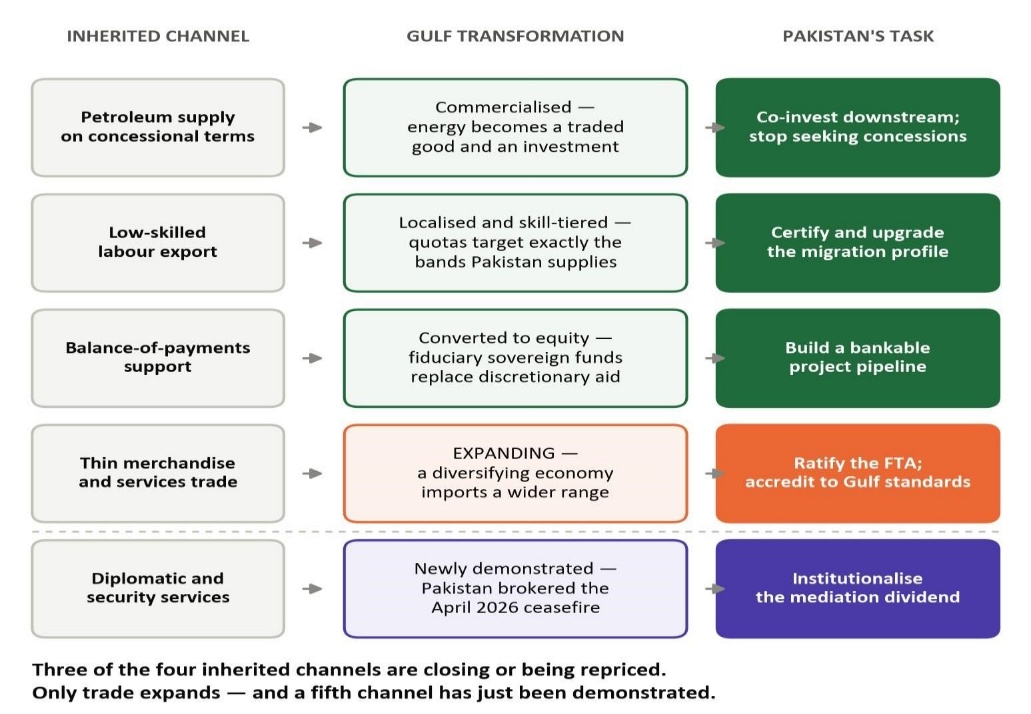
Source: Author's construction.
The repositioning task, stated compactly, is a move from rent recipient to co-producer.
What "Beyond Oil" actually means
The fiscal logic
Gulf diversification is not for branding purposes but in response to arithmetic. A number of the Gulf states' spending pledges are not viable at the current low levels of hydrocarbon prices, and the oil price that makes their spending balance economically "break-even" is higher than they can afford to sustain in the future. The answer lies in two things: the area where Saudi's growth is now taking place; and the velocity of the sovereign capital's flow.
In reality, the data on national accounts by the official quarterly statistics reveals that non-oil activity is the major source and not merely a supplement to the oil activity. Non-oil activities managed 2.6 of the 3.9 percentage points of real GDP growth in the second quarter of 2025, 4.6 percent recovering. Again 1.7 percentage points were contributed by them in the first quarter of 2026, (General Authority for Statistics, 2026). In fact, the Kingdom reports a similar situation in the trade figures it has published for itself, with non-oil exports worth of more than $166 billion in 2025, as well as more than 12,900 operating factories (Vision 2030, 2026).
The Public Investment Fund's assets under management totaled SAR 3,424 billion at the end of 2024, some $913 billion at the pegged exchange rate, compared to SAR 2,871 billion at the end of 2023. It's a 19 per cent rise from the previous year. Capital investment in the priority sectors of the Vision Realization Program increased to SAR 213 billion in 2024, with the total investment in these sectors surpassing SAR 642 billion since 2021 (Public Investment Fund, 2025). This is a fund that can get large, and move swiftly, to change the sectors it invests in.
The impact for Pakistan is on the spot. A non-oil driven growth process will indicate a non-oil volumes growth process of a Gulf whose sovereign capital is brought into use commercially at this level of magnitude, and whose import demand, labor demand and investment level are dictated by the manufacturing, logistical, tourism, healthcare and technological sectors versus oil.
Five transformation vectors
Table 1 Gulf transformation vectors and the foreign inputs they require
Vector
Illustrative programme or instrument
Implied demand Pakistan could supply
Sovereign capital as statecraft
Public Investment Fund: AuM of SAR 3,424bn (≈$913bn) at end-2024, up 19% in one year; SAR 213bn deployed into priority sectors in 2024; direct-operator model
Bankable equity opportunities in mining, energy, ports and agriculture
Food security and industrial localization
Saudi food production doubled from 6m tonnes (2016) to over 12m tonnes (2025); the Agricultural Development Fund lent $6.6bn+ between 2021 and 2025, generating $9.5bn+ in investment; a General Food Security Authority now manages strategic reserves; the world's largest food cluster was inaugurated in 2025; the Halal Saudi Center has introduced certification systems to facilitate trade; SALIC is strengthening supply chains through international investment. NIDLP adds sector localization targets: oil and gas 70%, pharmaceuticals 30%, aquaculture 300,000 tonnes. GSO 2055-1 revised in early 2026 to unify halal certification across the six markets
Halal meat, rice, cereals, fruit and processed food inputs; contract farming; cold-chain services; inward investment partnerships with SALIC
Human capital localization
Saudi MHRSD three-year Nitaqat Mutawar cycle from 2026 to localise 340,000+ private-sector jobs. Quotas are set profession by profession:
clinical nutrition and physiotherapy 80%, medical laboratories and procurement 70%, radiology 65%, marketing and sales 60%,
accounting 40% rising to 70% over five years, engineering 30% with a
SAR 8,000 minimum wage across 46 professions
Certified technical and engineering trades, where quotas remain low and wage floors are high, rather than elementary labour or the office and clinical professions now being closed
Energy transition and downstream
Utility-scale solar, green hydrogen and ammonia, petrochemical downstream integration
Refinery and petrochemicalco-investment, solar assembly, hydrogen off-take
Logistics, minerals and technology
Port and corridor investment, mineral supply-chain acquisition through Manara Minerals, data-centre and AI capacity build-out
Mineral equity and off-take, transit and warehousing, IT and ITenabled services
Source: Author's compilation from General Authority for Statistics, Public Investment Fund, Saudi Ministry of Human Resources and Social Development, Gulf Standardization Organization, and Vision 2030 programme documents.
Did the 2026 war accelerate or arrest this?
There is no uniform answer and it has implications for Pakistan's planning time frame. The war also led to an increase in financing costs, insurance premiums and construction risk, thus putting Vision-era revenue projections for greenfield timelines on hold and curtailing tourism. Against that, the closure of Hormuz demonstrated to the Gulf states themselves the cost of single-corridor dependence and single-commodity revenue. It strengthens the case for Red Sea and land-corridor capacity, for domestic food and industrial capability, and for revenue that does not require a tanker to clear a strait. On balance the war reads as an accelerant for the corridor, storage, food-security and localization vectors, and a brake on tourism and greenfield timelines. For Pakistan this is favorable, because the vectors that accelerated are the ones where Pakistan has something to offer.
The competitive field
Pakistan is not the only country that has noticed. India's Comprehensive Economic Partnership Agreement with the UAE was signed on 18 February 2022 and entered into force on 1 May 2022. Within two years bilateral merchandise trade had risen from $43.3 billion in FY2020-21 to $83.7 billion in FY2023-24, with non-oil trade reaching $57.8 billion and India's non-oil exports growing at an average 25.6 percent a year since entry into force. The stated objective is $100 billion of bilateral non-oil trade by 2030 (Government of India, 2025). A separate India-Oman CEPA has since been concluded. Pakistan's total merchandise exports to all six GCC states amount to approximately $2.6 billion.
The comparison that matters is not the level but the elapsed time. India moved from signature to operation in eleven weeks, and to a near-doubling of trade within two years. Pakistan signed a framework agreement with the GCC in 2004 and has no operative instrument twenty-two years later. The gap is not primarily one of capability. It is one of instruments, standards and institutional follow-through.
Evidence: Pakistan's obsolescing position
The labour channel is already restructuring
Most important is the data of Pakistan's emigration which presents a case far stronger than merely forecasting, that the Gulf is a fact that has already happened, in which transformation has already taken place. In 2025 there were 763,526 Pakistanis registered for work overseas - down from 862,625 in 2023 and 728,509 in 2024 - (Bureau of Emigration and Overseas Employment, 2026). The destination mix has been very unstable under those seemingly stable aggregates.
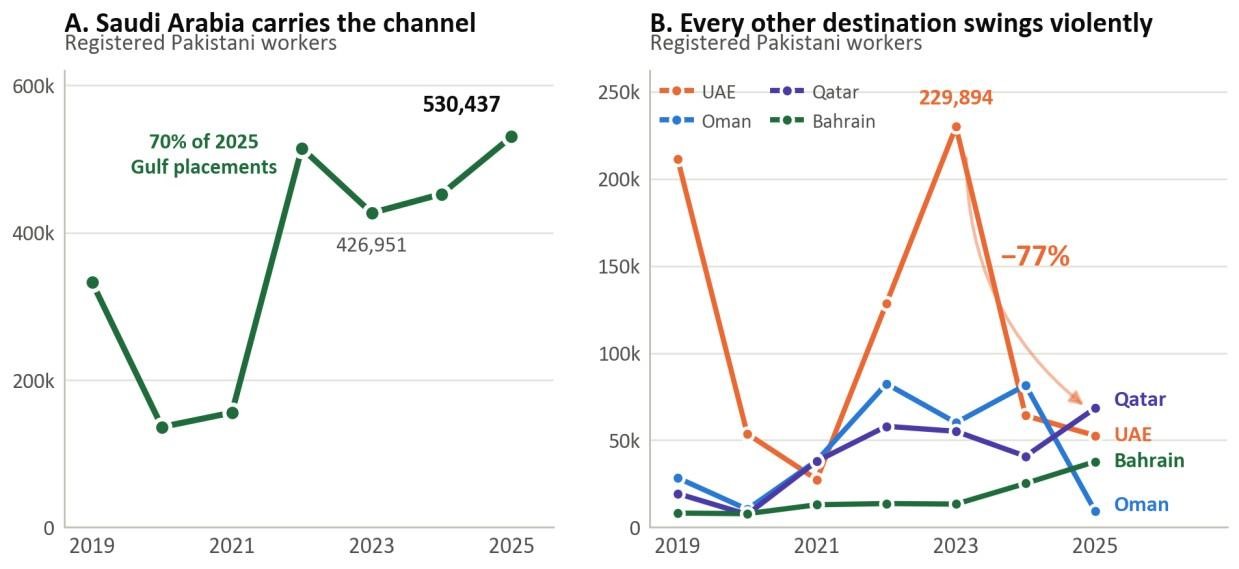
Source: Bureau of Emigration and Overseas Employment (2026), country-wise statistics to June 2026, full calendar years. Panels are shown separately because Saudi Arabia's volume would otherwise flatten the remaining series; no dual axis is used.
The three conclusions are as strong as their sum.
Firstly, the channel is focused on a restriction. There were 530,437 registrations for Saudi Arabia in 2025, representing almost 70 percent of all locations in the Gulf and 69 percent of Pakistan's total outflows, as construction activity in the country has a clear endpoint with Vision 2030.
Secondly, all other places have rocketed. Emirati car registrations reached a peak of 229,894 in 2023 but dropped to 52,664 in 2025 - a drop of seven in seven of 77 percent in two years - according to published reporting, which says the decline is due to tougher registration requirements and improved nationalization of labor in the UAE. Oman's collapse was sharper still, from 81,587 in 2024 to 9,375 in 2025. The other two countries (Qatar and Bahrain) did just the opposite: they gained ground to 68,386 and 37,726 respectively. Something that sees four out of five headings do more than 50 percent change in three years is not a secure income source.
Third, at the point of greatest reliance erosion of concentration is happening. Saudi Arabia gained 183,951 workers in the first half of 2026, which is about 30 per cent lower on a yearly basis compared to 2025. In the event that this continues, the one place taking in the others is shrinking.
This is partly because of the occupational composition which may make Pakistan vulnerable to these changes and not benefit from them.
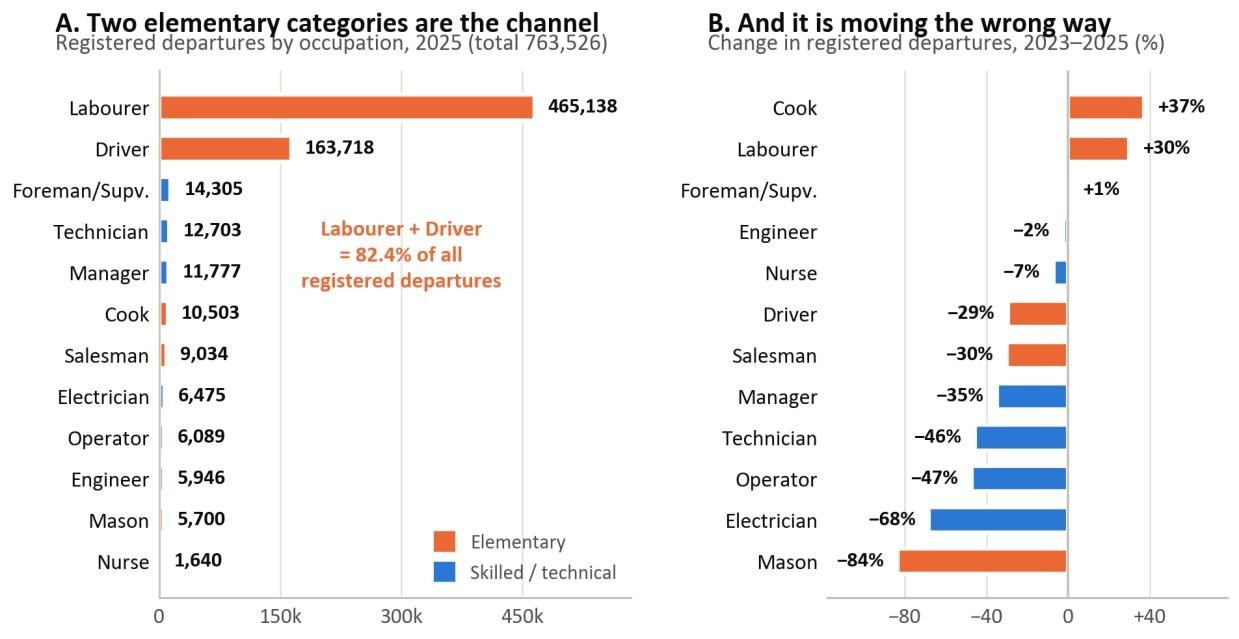
Source: Bureau of Emigration and Overseas Employment (2026), category-wise statistics. Classification into elementary and skilled bands is the author's, applied to BEOE's own occupational categories; the twelve categories shown do not sum to the annual total.
Concentration is in very high ASCENDING. In 2025, 82.4 per cent (or 628,856) of all registered departures are in two categories - laborer (465,138) and driver (163,718). The remainder is made up of laborer alone, who is 61 per cent of total. Then, there were 5,946 engineers, 12,703 technicians and 1,640 nurses.
The other one, the direction of travel, is more serious. As per the Gulf localization policy's skill criteria, the outflow from Pakistan shifted down the levels of skills rather than up between 2023-25. Laborer registrations rose 30 percent and cook's 37 percent, while technicians fell 46 percent, operator's 47 percent, electricians' 68 percent and mason's 84 percent. Engineers and nurses were flat to slightly down. Pakistan is moving in the opposite direction to the market it serves.
Meanwhile the fiscal importance of the channel has grown. Workers' remittances reached a record $41.6 billion in FY2025-26, up 8.6 percent from $38.3 billion in FY2024-25 (State Bank of Pakistan, 2026a). The Gulf supplied $22.52 billion of that, or 54.1 percent: Saudi Arabia $9.78 billion, the UAE $8.81 billion, Oman $1.29 billion, Qatar $1.18 billion, Kuwait $0.89 billion and Bahrain $0.57 billion (State Bank of Pakistan, 2026c). The Gulf share is essentially unchanged from the 54.5 percent reported for 2025 by Shah and Islam (2026), while the level has risen by more than $1.6 billion.
This is where the two halves of the labour channel come apart, and it is the most important observation in this section. Remittances are earned by the accumulated stock of migrants already resident in the Gulf. Registrations measure the flow of new placements that will replenish that stock. The two are now moving in opposite directions. Oman remitted $1.29 billion in FY2025-26, more than Qatar, while its intake of new Pakistani workers fell to 9,375 in 2025 and 220 in the first half of 2026. The Emirati stock continues to remit $8.81 billion a year on the strength of placements made before 2024, not the 52,664 of 2025.
Record remittances are therefore being read as evidence of strength when they are a lagging indicator. The stock is continuing to pay a paycheck, while the pipeline nearing its end is aging and the mix is changing to bands of the lowest pay and least Gulf demand among the occupations. For several years the failure will not be listed in the remittance series and when it does will have passed the adjustment period.
The trade channel is the headroom
Pakistan's trade relationship with the Gulf is the mirror image of its labour relationship: minimal on the export side, dominant on the import side.
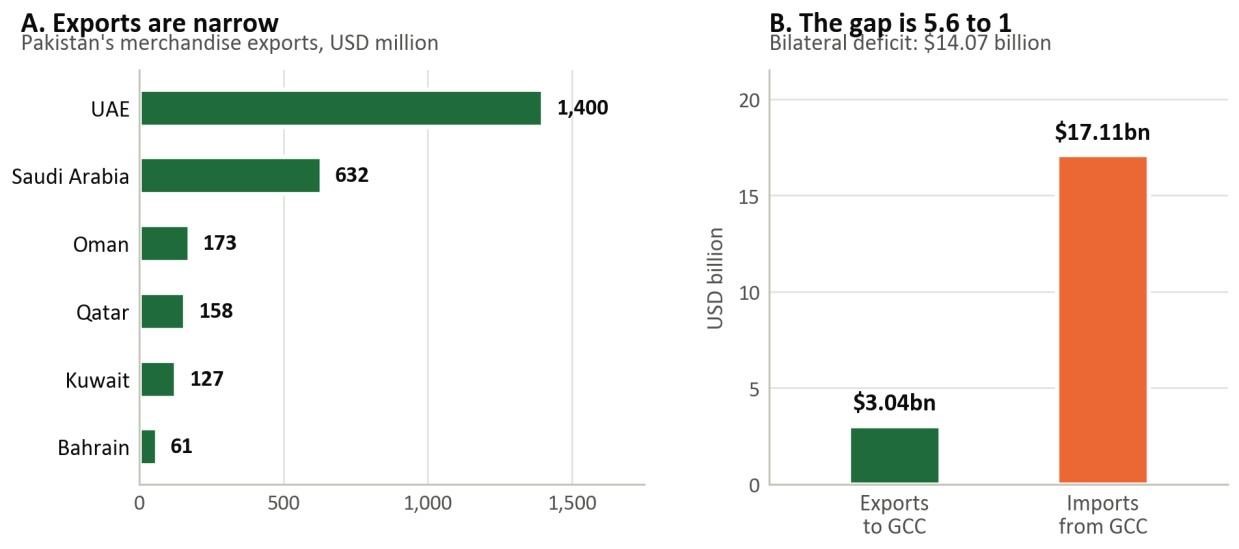
Source: Panel A compiled from International Trade Centre (2026) country data; Panel B from Shah and Islam (2026). Panel A values are for 2023 and should be updated to the latest full year before publication.
Shah and Islam (2026) report exports to the GCC of $3.04 billion against imports of $17.11 billion, a bilateral deficit of $14.07 billion. Taken together with China, the GCC accounts for roughly 90 percent of Pakistan's total trade deficit.
This is not a capacity ceiling. Pakistan is among the world's leading rice exporters and a significant agricultural producer, in a region that imports most of its food and has just unified its halal certification requirements (Gulf Standardization Organization, 2026). Its services capability is no longer marginal either: information technology exports reached a record $4.6 billion in FY2025-26, up 21 percent from $3.81 billion, within total services exports of $10.03 billion, with freelance earnings exceeding $1 billion for the first time (State Bank of Pakistan, 2026b). Almost none of this is oriented toward the Gulf, which is geographically adjacent, in a compatible time zone, and building digital capacity at speed.
The most important constraint on binding is elasticity and standards, and not volume. According to Shah and Islam (2026) the price elasticities of export and import are 1.10 and −0.45, respectively, indicating that Pakistani exports are very responsive to price, whereas imports are sensitive to cost. When the MarshallLerner condition is not met, depreciation cannot balance out the trade. The long-run elasticities underlying the estimates can be traced back to Baluch and Bukhari (2012) whose ARDL results indicate that the elasticities of imports are −0.53 in terms of relative prices and 1.22 in terms of income, respectively. Even though numbers reported in the secondary literature vary, the direction of the result remains consistent (see Appendix A.4).
GCC-6 imports seven times more non-oil goods, worth $536.5 billion annually. It continues to come from Pakistan at the rate of $2.44 billion, which is equivalent to 0.455 per cent of its total requirement. The formal question (the Finger-Kreinin complementarity index between Pakistan's export structure and GCC import demand is 16.4 out of 100) is what Pakistan exports and what the Gulf wants to import hardly overlap.
It represents a fatalistic view (no, Pakistan doesn't make something that the Gulf wants) and the product-level statistics say otherwise. Pakistan already demonstrates what it can achieve when it competes. It holds 32.0 percent of the GCC's bovine meat imports, 24.2 percent of bed linen, 14.1 percent of potatoes and 12.5 percent of rice. The problem is not capability in the abstract. It is that Pakistan sells the Gulf its commodities and almost none of its manufactures.
The screen below applies three filters to every HS-4 line. The GCC must import more than $200 million of it; Pakistan must export more than $100 million of it to the world, proving it can make the product at scale; and Pakistan's share of the GCC market must be under 5 percent. Twenty-two lines qualify. The untapped column asks what Pakistan would sell at a 10 percent share, a rate below what it already achieves in rice, bed linen and meat, capped so that the implied sale never exceeds what Pakistan currently exports of that product to the entire world.
Table 2 Where Pakistan has proven capability and no Gulf market share
| HS-4 | Product | GCC-6 imports ($m) | Pakistan's world exports ($m) | Pakistan's share of GCC market | Untapped ($m) | Gulf demand driver |
| 7403 | Refined copper, unwrought | 4,841 | 704 | 0.09% | 480 | Minerals and industry |
| 3004 | Medicaments, packaged | 13,166 | 285 | 0.04% | 280 | Pharmaceutical localization (30%) |
| 9018 | Medical and surgical instruments | 3,029 | 447 | 0.93% | 275 | Health-sector expansion |
| 6204 | Women's suits, dresses, skirts (woven) | 2,562 | 403 | 0.72% | 238 | Consumer and retail growth |
| 6109 | T-shirts and vests (knitted) | 1,693 | 609 | 0.73% | 157 | Consumer and retail growth |
| 2106 | Food preparations n.e.s. | 2,435 | 131 | 0.31% | 123 | Food security |
| 6403 | Footwear with leather uppers | 1,748 | 126 | 0.27% | 122 | Consumer and retail growth |
| 3907 | Polyethers, epoxide resins | 1,284 | 177 | 0.80% | 118 | Industrial localization |
| 1701 | Cane and beet sugar | 2,035 | 126 | 0.54% | 115 | Food security |
| 1005 | Maize | 1,416 | 346 | 2.15% | 111 | Food security |
| 6104 | Women's suits, dresses (knitted) | 945 | 254 | 1.07% | 84 | Consumer and retail growth |
| 6110 | Jerseys, pullovers, cardigans | 876 | 677 | 1.27% | 76 | Consumer and retail growth |
| 1704 | Sugar confectionery | 731 | 110 | 4.05% | 44 | Food security |
| 9506 | Sports and gymnastics equipment | 543 | 327 | 2.11% | 43 | Tourism and events |
| Remaining eight screened lines | 3,021 | 2,820 | 225 | mixed | ||
| All 22 screened lines | 40,325 | 2,490 |
Source: Author's calculations from UN Comtrade (2026), HS-4, calendar year 2023, mineral fuels (ch.27) and precious metals (ch.71) excluded. Method and benchmark assumptions at Appendix A.1 to A.3.
Three things follow.
The gap is worth more than the existing relationship. The twenty-two screened lines carry $2.49 billion of untapped exports against current non-oil exports to the GCC of $2.44 billion. Capturing them would slightly more than double what Pakistan sells the Gulf, in products it already manufactures and already sells elsewhere.
It is concentrated in manufactures. Apparel alone, chapters 61 and 62, accounts for $663 million of the gap. Pakistan is one of the world's significant garment exporters, and its share of the GCC market for knitted apparel runs between 0.7 and 4 percent. It sells the Gulf rice at 12.5 percent and T-shirts at 0.73 percent. Rice transactions occur in food channels in which tariffs and rules of origin have very little impact, while goods in the form of clothing do. The cost in terms of products of an unimplemented trade agreement.
The drivers of demand are the ones that were identified in Section 3. The medical instruments and pharmaceuticals are monitoring health sector expansion and the pharmaceutical localization target of 30%. Cement tracks giga-project construction, bedding tracks the hospitality build-out, sports equipment tracks the events strategy, and food preparations and sugar track the food-security programme. The screen maps onto the specific Gulf programmes creating the demand.
The capital channel is converting
The third channel is changing form rather than closing, and one transaction illustrates the change better than any aggregate. Manara Minerals, the mining vehicle backed by the Public Investment Fund, is negotiating an equity stake in the Reko Diq copper-gold project. Reported terms have varied during negotiation, spanning a stake of 10 to 20 percent and consideration of $500 million to $1 billion, with the most frequently reported structure a 15 percent stake taken in two tranches, the first at signing and the second at final investment decision. The stake would be purchased from the federal government's 25 percent holding in a $9 billion project in which Barrick Gold holds 50 percent, a holding Barrick has said it will not reduce, and the Government of Balochistan the remaining 25 percent. The transaction structure was approved by the Special Investment Facilitation Council apex committee. First production is expected toward the end of 2028. Because reported figures have moved and the transaction was not confirmed as closed at the time of writing, these numbers should be read as the reported negotiating range rather than settled terms.
This is different from the historical pattern in three aspects. It is not a deposit, but equity. Does not set the prices or tranches according to political needs, but rather against project milestones. It is sector-strategic- it is getting the mineral supplies to enable a building of industrial capacity in a Gulf State, not to provide fiscal assistance to an ailing partner.
Now the Gulf is bolstered with its capitals and it suggests another competence on Pakistan's part. Di diplomatic access is required for the deposit. To achieve equity, you need a project pipeline, clean title, dispute resolution credibility in addition to profit repatriation certainty. The four other types are not developed and Pakistan has put its money into the first.
The opportunity set and why it has not been captured
Four prerequisites will be met for screening of opportunity of candidates Scale of Gulf demand, capability of Pakistan, Time to market, Intensity of competition. When applied to the vectors designated in Section 3, the outcome is not uniform and disclosure of the weaker cells is more important than the exfoliation of the stronger cells.
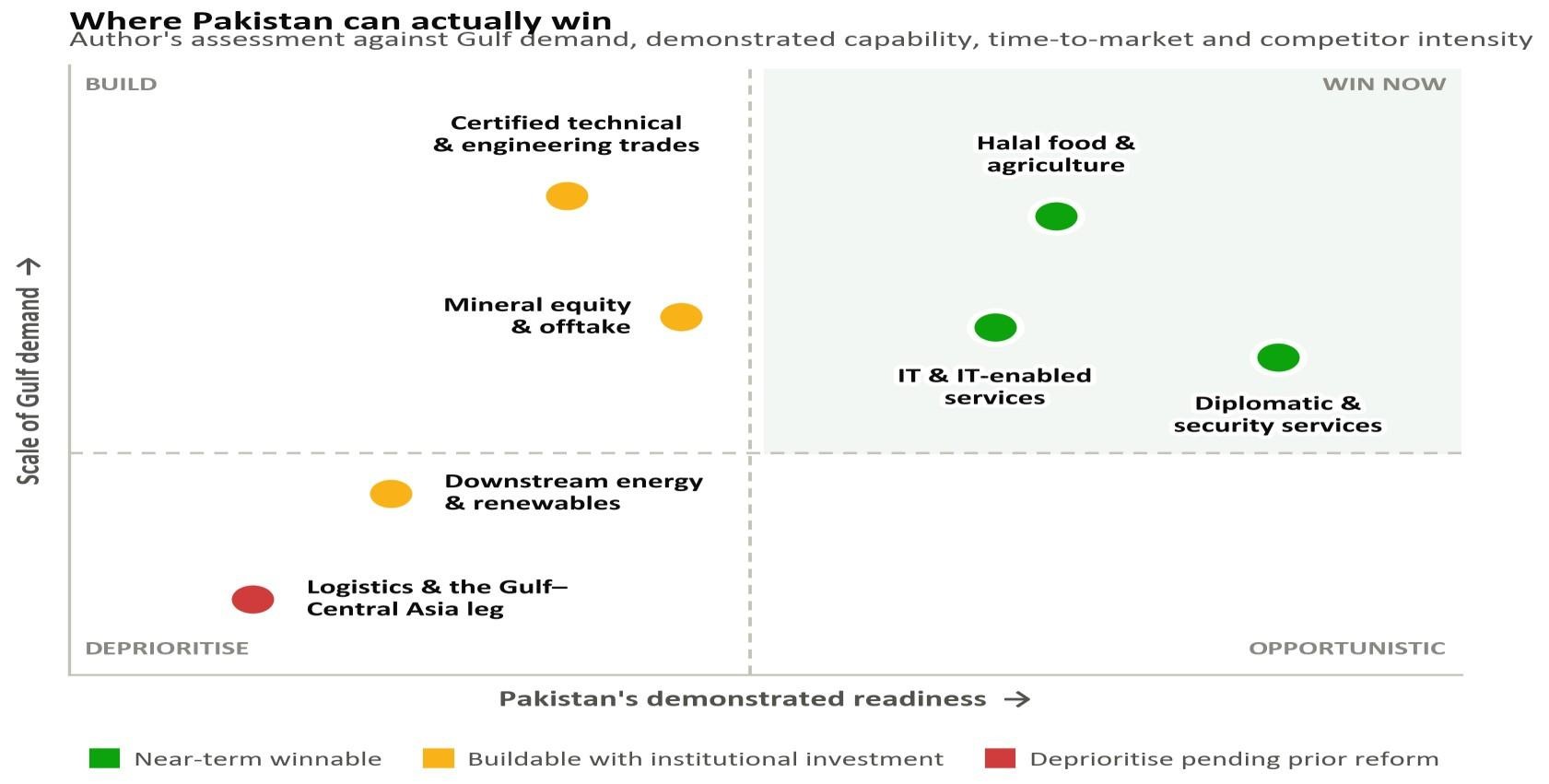
Source: Author's assessment against the four screening criteria. Positions are ordinal judgements, not measured values.
Table 3 Opportunity screening matrix
| Opportunity | Gulf demand | Pakistan capability | Time to market | Competition | Assessment |
| Halal food, rice, meat and processed agriculture | High: structural food-import dependence; unified GSO 2055-1 standard from 2026; Halal Saudi Center certification infrastructure operating; SALIC investing in foreign supply chains | High: established rice and agricultural export base | Short, 12 to 24 months if accreditation is resolved | Moderate: India, Brazil, Australia | Win now |
| Certified technical and engineering trades | High: engineering quotas remain at 30%, leaving 70% open, with a SAR 8,000 wage floor across 46 professions | Low to moderate: capacity exists, certification and recognition do not | Medium, 2 to 4 years for accredited pipelines | High: India, Philippines, Bangladesh | Build, highest strategic value |
| Licensed clinical professions | Narrowing: radiology 65%, medical laboratories 70%, clinical nutrition and physiotherapy 80% localized | Low: accreditation not recognized | Long | High | Selective only |
| IT and ITenabled services | High: data-centre and digital build-out | Moderate to high: $4.6bn export base growing at 21% | Short, 12 to 24 months | High: India dominant | Win now, underexploited |
| Mineral equity and off-take | High: supply-chain security mandates | Moderate: assets are world-class, governance is the constraint | Medium: Reko Diq precedent established | Low: asset-specific | Build on precedent |
Logistics and the Gulf- Central Asia leg | Moderate: corridor diversification after Hormuz | Low: Gwadar underperforms, Karachi congested | Long | High: IMEC, Iranian and Turkish routes | Deprioritize pending reform |
Diplomatic and security services | Demonstrated in 2026 | Demonstrated | Immediate | Very low: few substitutes | Institutionalize |
Source: Author's assessment. Color coding: green, near-term winnable; amber, buildable with institutional investment; red, deprioritize pending prior reform. Localization percentages from Ministry of Human Resources and Social Development (2026).
The structure of Saudi localization quotas deserves attention, because it disposes of a comfortable assumption. "Move up the skill ladder" is the standard prescription for Pakistani labour export, and it is only half right. The quotas are not applied uniformly. Clinical nutrition and physiotherapy are 80 percent localized, medical laboratories and procurement 70 percent, radiology 65 percent, marketing and sales 60 percent, and accounting is scheduled to rise from 40 to 70 percent within five years. The "more improving" is generally limited to the credentialed office and licensed clinical professions where there is greater availability of Saudi nationals. They are closing.
The exception that is the opportunity is engineering. Its allowances are 30 per cent with 70 per cent reserved for expatriates in 46 professions and a minimum wage of SAR 8,000 (about $2,130) per month as compared to the SAR 4,600 per month minimum wage of a laborer or driver. The Gulf is nationalizing professions that they can fill from the local pool and opening up the technical trades they can't.
This leaves Pakistan with a fairly clear-cut goal: to develop technical and engineering trades to international standards in Saudi and Emirati countries - where there are few job quotas, high-wage ceilings, and a true shortage of local supply. It also accounts for the expense of the current trajectory! While reducing technicians (-46 percent) and electricians (-68 percent), Pakistan added 30 percent more laborers to the one tier, but became 100 percent more supply of laborers with no wage floor in the other tier.
This range of opportunities is contrasted by six constraints to describe how Pakistan is doing.
Standards and certification: Pakistan's halal and sanitary-phytosanitary accreditation is not aligned to the revised GSO regime, and its technical and engineering qualifications are not recognized by Saudi or Emirati licensing authorities. This binds on the two best opportunities, and it is administrative rather than economic.
Energy cost competitiveness: With an export price elasticity above unity, Pakistani exporters lose Gulf market share whenever domestic energy costs rise. Shah and Islam (2026) note the asymmetry sharply: Pakistan raised domestic fuel prices by PKR 55 per litre, or 20.6 percent, during the 2026 crisis, while China and India held prices unchanged.
Instrument absence: Pakistan and the GCC signed a framework agreement to negotiate a free trade agreement on 24 August 2004. Negotiations were launched in 2006, lapsed, and resumed in 2021. The agreement was initial-led in September 2023, and in late 2025 the Prime Minister described it as nearly finalized. It remains signed but not in effect, and has not been notified to the World Trade Organization (Asian Development Bank, 2026). India signed its CEPA with the UAE in February 2022 and had it operating within three months. A framework agreement that has not produced an operative instrument in twenty-two years is not a negotiating problem; it is the discontinuity problem in its most consequential single instance.
Investor protection: Gulf sovereign capital requires enforceable dispute resolution and profit-repatriation certainty. Pakistan's record on contract sanctity and its foreign-exchange management practice both raise the required return.
Institutional ambiguity: The SIFC has improved transaction speed, as Reko Diq demonstrates, but the division of authority between it, line ministries and provincial governments remains unclear to counterparties.
Policy discontinuity: Most of the recommendations in Section 6 have been announced before, in some cases repeatedly. The constraint is not the absence of policy but the absence of continuity.
Policy: From opportunism to a gulf strategy
Table 4 Policy matrix
| Horizon | Action | Owner | Instrument | Indicator |
Immediate (0 to 12 months) | Bring the Pakistan-GCC FTA into force and publish the schedules | Commerce Division, Cabinet | Ratification and notification | Agreement in force within 12 months |
| Accredit national halal and SPS certification to the revised GSO 2055-1 regime | Ministry of National Food Security; PNAC | Mutual recognition of conformity assessment | Certificates accepted without re-testing in Saudi Arabia and the UAE | |
| Negotiate mutual recognition agreements for engineering and priority technical trades first, where quotas remain at 30% and a SAR 8,000 wage floor applies; treat licensed clinical professions as a second, selective tier | Overseas Pakistanis Division; NAVTTC; Pakistan Engineering Council | Bilateral MRAs with the Saudi Council of Engineers and relevant UAE authorities | First recognized cohorts placed | |
| Publish a Gulf-facing bankable project pipeline with title, tariff and off-take documented | SIFC; Board of Investment | Standard-form project information memoranda | Pipeline published; two transactions in due diligence | |
| Establish the Gulf Shock Dashboard proposed by Fraz (2026) | MoF, SBP, Petroleum Division, PSX, NCCPL | Single weekly publication during oil-shock episodes | Operational within one quarter | |
| Medium (1 to 3 years) | Reorient TVET output to Gulf-certified occupational standards | NAVTTC, TEVTAs | Curriculum alignment; third-party assessment | Rising share of skilled and above in GCC-bound outflow |
| Target the screened highcomplementarity export lines with logistics, cold-chain and tariff remedies | Commerce Division; TDAP | Sector plans against the Table 2 screen | Pakistan's share of screened GCC lines | |
| Upgrade bilateral investment treaties and dispute resolution; codify repatriation | Law and Finance Divisions | BIT renegotiation; enforceable arbitration | Reduction in country risk premium demanded | |
| Position the GCC as an anchor market for IT and IT-enabled services | MoITT; P@SHA | Gulf market-entry programme; data-adequacy arrangements | GCC share of IT exports | |
| Structural (3 to 10 years) | Reduce industrial energy costs to restore export competitiveness | Power and Petroleum Divisions | Circular-debt resolution; tariff rationalization | Industrial tariff relative to regional competitors |
| Shift the migration profile into the technical tier that Gulf localization leaves open, rather than the office and clinical tier it is closing | Overseas Pakistanis Division | Skill-tiered emigration policy aligned to published quota schedules | Remittance per migrant | |
| Institutionalize the 2026 mediation dividend | MoFA; MoF | Structured economic dialogue with Gulf and Western partners | Conversion into investment and market-access commitments |
Source: Author's compilation.
Four points deserve emphasis.
Bringing the agreement into force is the highest-leverage single act available
The Pakistan-GCC FTA covers services, digital trade, investment, standards, tourism and intellectual property as well as goods, and is the most comprehensive instrument Pakistan has negotiated with any partner. It is signed but not in effect and has not been notified to the World Trade Organization; the remaining steps are procedural rather than substantive. India's experience indicates the order of magnitude at stake: a comparable instrument carried India-UAE trade from $43.3 billion to $83.7 billion within two years of entering into force. Table 2 gives the Pakistani equivalent, $2.49 billion of trade sitting in products Pakistan already makes.
Certification is cheaper than any subsidy and binds harder
Pakistan's two best opportunities, halal food and certified technical labour, are both blocked by conformity-assessment and qualification-recognition gaps that are administrative in nature. The revised GSO halal standard, by unifying requirements across the GCC, has made a single accreditation effort sufficient for six markets. That window will not stay open indefinitely as competitors accredit.
The objective in energy should change from price to participation
Pakistan has invested a lot of diplomatic effort to obtain "concessional" supply conditions. A fine commercial requirement for a Gulf sovereign fund with about $913 billion to deploy through it at about SAR 213 billion per annum is no good when it comes to concessions, but, yes, co-investment. A new Gulf ready to take proposals of a transforming kind: upgrading refinery, integrating petrochemicals and solar production.
The mediation dividend is perishable
Diplomatic capital of the caliber which Pakistan is able to acquire in April 2026 becomes eroded if it remains in the form of soft cash promises. The change isn't overnight and is a product of a specific economic program that goes hand in hand with diplomacy.
Conclusion
This was the third of three PIDE Viewpoints prior to this one that were correct in their view of the danger. Infrastructure such as oil prices, freight rates, the external accounts and investor sentiments, and ultimately the closure of the Strait of Hormuz in 2026 or closer by demonstrated the four pathways at play in Pakistan.
Hormuz was a warning on the old relationship, though, and the change of the Gulf is a warning not to think the old relationship will continue. The four channels through which Pakistan has engaged the Gulf for five decades were artifacts of the rentier era. Three of them, concessional oil, elementary labour and rescue finance, are closing or being repriced by the Gulf's own choices. The fourth, trade in goods and services, is the one that a diversifying Gulf will expand, and it is the one Pakistan has left underdeveloped. The 77 percent fall in Emirati demand for Pakistani workers, and the near-total closure of the Omani market in a single year, are not market fluctuations. They are a preview. That Pakistan's response has been to send 30 percent more labourers is the measure of the adjustment problem.
Pakistan enters this transition with an unusual advantage and an unusual liability side by side. It has just demonstrated diplomatic value that few states could have supplied. It has also spent the same period unable to sell six wealthy, adjacent, food-importing economies more than $2.6 billion of goods, while $2.49 billion of trade sits unclaimed in products it already exports to the rest of the world. The instruments to close that gap are identified, negotiated and, in the case of the GCC Free Trade Agreement, already signed. What remains is ratification, accreditation and continuity, which is to say the parts that have historically failed.
The policy task is not to obtain cheaper oil. It is to become a different kind of counterparty.
Appendix A: Methodology and data notes
A.1 Capability and market-share screen
Table 2 is built at HS-4 from UN Comtrade reported flows for calendar year 2023: GCC-6 imports from the world, Pakistan's exports to each GCC state, and Pakistan's exports to the world. A line is retained when GCC-6 imports exceed $200 million, Pakistan's exports to the world exceed $100 million, and Pakistan's share of the GCC market is below 5 percent.
The untapped column is GCC-6 imports multiplied by 10 percent, less Pakistan's actual exports of that line to the GCC, capped so that the implied sale never exceeds Pakistan's current exports of that product to the entire world. The 10 percent benchmark is stated rather than estimated, and is deliberately conservative: Pakistan already holds 12.5 percent of GCC rice imports, 24.2 percent of bed linen and 32.0 percent of bovine meat. The result is an order-of-magnitude indication of foregone trade, not a forecast.
On trade elasticities a further discrepancy should be recorded. Shah and Islam (2026, Table 3) report import price and income elasticities of −0.45 and 1.50, attributed to Baluch and Bukhari (2012). The original working paper reports long-run ARDL estimates of −0.53 and 1.22. The qualitative conclusion is unaffected, since imports remain price-inelastic and income-elastic, but authors citing these elasticities should take them from the original source rather than the secondary report.
Figures 2 and 3 use full calendar years, and totals combine placements through BE&OE and through the Overseas Employment Corporation. This matters, because several widely circulated figures report the BE&OE component alone as though it were the national total, for example 530,256 rather than 530,437 for Saudi Arabia in 2025, and 762,499 rather than 763,526 for the 2025 aggregate. Where 2026 is referenced it covers January to June only and is identified as such. It is annualized once, explicitly, in the discussion of the Saudi intake, and that annualization assumes an even intra-year distribution which the monthly data do not guarantee.
Three figures rest on reporting of official data rather than the issuing institution's own publication and should be treated accordingly: the information technology export line, for which SBP publishes monthly rather than annual totals; the country-level export values in Figure 4, which are for 2023; and the Reko Diq transaction terms, which varied during negotiation and are presented as a range.
Figure construction: All figures were produced from a single documented script. The categorical palette was validated for color-vision-deficiency separation, lightness band, chroma floor and contrast against a white print surface before use. Status colors in Figure 5 are paired with legend labels so that no distinction is carried by color alone.
Key Message
The 2026 Gulf crisis had two outcomes for Pakistan one is in the policy and the other is not. The closure of the Strait of Hormuz was also one of the most threatening events for the most vulnerable economy in the world that was Pakistan. It was also the state that brokered the ceasefire, since directly involving the United States and Iran at the highest of levels has not happened since 1979. Pakistan's diplomacy for this reason is in a peculiar situation, with diplomatic capital on one hand and limited geoeconomic capital on the other.
That's an asymmetry that can [and must be] corrected through the Gulf's own transformation. A Gulf whose development is now hinged on non-oil businesses that is importing their food supply goods from other nations, and has amalgamated a 'halal' business legalization in all six markets, whereas as has Pakistan, needs the same tools: certified labor, 'halal' business certified food supply goods, mineral supplies and digital services.
The trade data put a number on the cost of inaction. In twenty-two product lines that Pakistan already exports competitively to the rest of the world, it holds under 5 percent of a GCC market worth $40 billion. The gap is $2.49 billion, slightly more than Pakistan's entire current non-oil trade with the region.
Bringing the Pakistan-GCC Free Trade Agreement into force, negotiating mutual recognition of skill certifications, and accrediting to the unified GSO halal standard are worth more to Pakistan's external account over the next decade than any achievable improvement in oil import terms.
References
- Asian Development Bank. (2026). Pakistan–Gulf Cooperation Council Free Trade Agreement: Status. Asia Regional Integration Center. https://aric.adb.org/fta/pakistan-gulf-cooperation-council-free-tradeagreement
- Balassa, B. (1965). Trade liberalisation and "revealed" comparative advantage. The Manchester School, 33(2), 99–123. https://doi.org/10.1111/j.1467-9957.1965.tb00050.x
- Baluch, K. A., & Bukhari, S. K. H. (2012). Price and income elasticity of imports: The case of Pakistan (SBP Working Paper Series No. 48). State Bank of Pakistan, Research Department. https://www.sbp.org.pk/publications/wpapers/2012/wp48.pdf
- Beblawi, H., & Luciani, G. (Eds.). (1987). The rentier state (Nation, State and Integration in the Arab World series). Croom Helm; Istituto Affari Internazionali.
- Blackwill, R. D., & Harris, J. M. (2016). War by other means: Geoeconomics and statecraft. The Belknap Press of Harvard University Press.
- Bureau of Emigration and Overseas Employment. (2026). Statement showing number of Pakistani workers registered for employment abroad during the period 1971–2026 (till June): Country-wise and category-wise. Government of Pakistan. https://beoe.gov.pk/reports-and-statistics
- Farooq, S. (2026). The Middle East conflict and its implications for Pakistani migrant workers (Policy Viewpoint No. 54:2026). Pakistan Institute of Development Economics.
- Finger, J. M., & Kreinin, M. E. (1979). A measure of "export similarity" and its possible uses. The Economic Journal, 89(356), 905–912. https://doi.org/10.2307/2231506
- Fraz, A. (2026). From the Strait of Hormuz to the PSX: What the Iran-Israel war reveals about Pakistan's economic vulnerability (Policy Viewpoint No. 57:2026). Pakistan Institute of Development Economics.
- General Authority for Statistics. (2026). Gross domestic product by expenditure and by economic activity: Quarterly national accounts (Q2 2025 and Q1 2026 releases). GASTAT. https://www.stats.gov.sa/
- Government of India. (2025, February 18). India–UAE Comprehensive Economic Partnership Agreement completes 3 years of signing [Press release]. Ministry of Commerce and Industry, Press Information Bureau.
- Gulf Standardization Organization. (2026). GSO 2055-1: Halal food, general requirements (revised). GSO.
- Haq, A. U., & Nawaz, S. M. N. (2026). Pakistan's exposure to a Strait of Hormuz shock: Fuel pricing, inflation, and external vulnerability (PIDE Working Paper No. 2026:02). Pakistan Institute of Development Economics.
- Hvidt, M. (2013). Economic diversification in GCC countries: Past record and future trends (Research Paper No. 27, Kuwait Programme on Development, Governance and Globalisation in the Gulf States). London School of Economics and Political Science. https://eprints.lse.ac.uk/55252/
- International Trade Centre. (2026). Trade Map: Trade statistics for international business development. ITC. https://www.trademap.org/
- Ministry of Human Resources and Social Development. (2026). Nitaqat Mutawar programme: Sectoral localisation decisions, 2025–2028. MHRSD. https://www.hrsd.gov.sa/en
- Naurin, A. (2026). World oil price volatility, Middle East geopolitics, and Pakistan's inflation dynamics (Policy Viewpoint No. 53:2026). Pakistan Institute of Development Economics.
- Public Investment Fund. (2025). PIF annual report 2024. PIF. https://www.pif.gov.sa/en/investors/annual-reports/
- Shah, S. H., & Islam, W. (2026). The Middle East crisis impact on Pakistan's trade (Policy Viewpoint No. 56:2026). Pakistan Institute of Development Economics.
- State Bank of Pakistan. (2026a, July 9). Press release of workers' remittances for June 2026 [Press release]. SBP.
- State Bank of Pakistan. (2026b). Summary balance of payments (BPM6), June 2026. SBP.
- State Bank of Pakistan. (2026c). Country-wise workers' remittances [Data set]. SBP EasyData. https://easydata.sbp.org.pk/
- The chronology of the 2026 conflict and the Islamabad Talks was established from contemporaneous international reporting, principally France 24 (8 April 2026) and Al Jazeera (15 June 2026).
- United Nations. (2026). UN Comtrade database [Data set]. United Nations Statistics Division. https://comtradeplus.un.org/
- Vision 2030. (2026). Vision 2030 annual report 2025; and National Industrial Development and Logistics Program documentation. Kingdom of Saudi Arabia. https://www.vision2030.gov.sa/en/
- Young, K. E. (2023). The economic statecraft of the Gulf Arab states: Deploying aid, investment and development across the MENAP (Middle East Institute Policy Series). I.B. Tauris.
Cite this article
-
APA : Yar, R. (2026). Beyond Oil: Gulf Geoeconomic Transformation in the Emerging Middle Eastern Order. Global Foreign Policies Review, IX(II), 78-95. https://doi.org/10.31703/gfpr.2026(IX-II).09
-
CHICAGO : Yar, Rehman. 2026. "Beyond Oil: Gulf Geoeconomic Transformation in the Emerging Middle Eastern Order." Global Foreign Policies Review, IX (II): 78-95 doi: 10.31703/gfpr.2026(IX-II).09
-
HARVARD : YAR, R. 2026. Beyond Oil: Gulf Geoeconomic Transformation in the Emerging Middle Eastern Order. Global Foreign Policies Review, IX, 78-95.
-
MHRA : Yar, Rehman. 2026. "Beyond Oil: Gulf Geoeconomic Transformation in the Emerging Middle Eastern Order." Global Foreign Policies Review, IX: 78-95
-
MLA : Yar, Rehman. "Beyond Oil: Gulf Geoeconomic Transformation in the Emerging Middle Eastern Order." Global Foreign Policies Review, IX.II (2026): 78-95 Print.
-
OXFORD : Yar, Rehman (2026), "Beyond Oil: Gulf Geoeconomic Transformation in the Emerging Middle Eastern Order", Global Foreign Policies Review, IX (II), 78-95
-
TURABIAN : Yar, Rehman. "Beyond Oil: Gulf Geoeconomic Transformation in the Emerging Middle Eastern Order." Global Foreign Policies Review IX, no. II (2026): 78-95. https://doi.org/10.31703/gfpr.2026(IX-II).09